
GREGOR SCHNEIDER
14 Fotografien, 2 Videos, 1 Mülltonne und 27 Bücher
November 14 - December 18, 2026
250 West Broadway, 4th fl.
New York, NY 10013
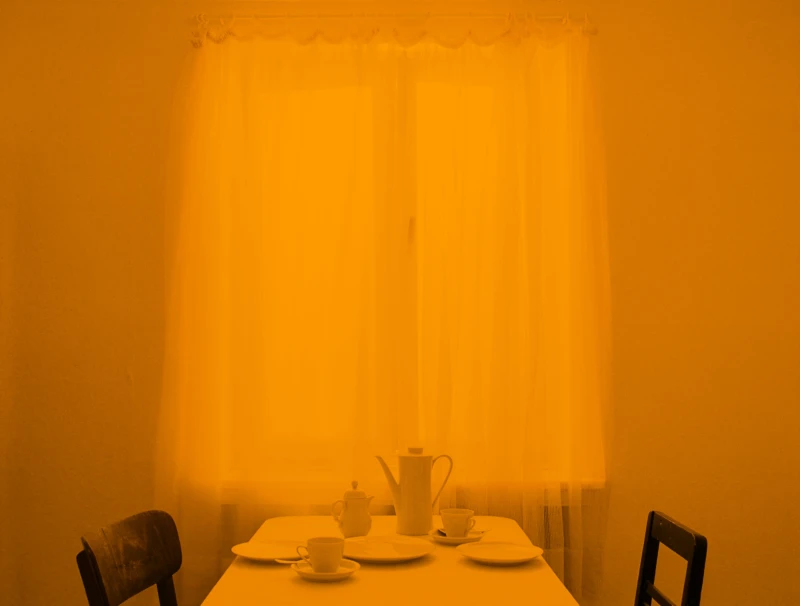
Okey Dokey Konrad Fischer is delighted to present a selection of Gregor Schneider’s work in our Tribeca office. Part reading room, part exhibition, the presentation brings together 14 photographic works, two videos, one sculpture and 35 books spanning Schneider’s career.
Schneider’s best-known work is his Gesamtkunstwerk, Haus u r, in Mönchengladbach-Rheydt, the city where he was born and still lives. Begun by the artist in 1985 still ongoing, it is considered to be among the most influential and unique spatial works in contemporary art. Built entirely from the inside, it consists of newly constructed fully enclosed rooms within existing rooms, complete with walls, ceilings and floors; motorized rooms that can be rotated slightly; and rooms that have been sealed off and made completely inaccessible. In 2001, Schneider represented Germany in the 49th Venice Biennale and presented Totes Haus u r in the form of 24 rooms that had been either removed or copied from Haus u r and reassembled in the German Pavillion, which earned him the Golden Lion that year. Separate from the house itself, Schneider has created a sort of encyclopedia of rooms, which is housed in a storage hall where past rooms have been preserved.
Over the course of four decades, training his attention on the built environment and charged architecture, Schneider has created a body of work that addresses some of society’s most sensitive and painful issues. He reconstructed the sterile high-security cells of the Guantánamo Bay detention camp as “white cubes” of sorts, he spoke about the idea of creating a public room for dying and expressed his wish to show a person dying a natural death in a gallery, a proposal that provoked death threats. Schneider has staged other cultural interventions; he attempted to unite an Islamic and a Catholic place of worship, and created a temple featuring goddesses in Kolkata. In 2013, he bought Joseph Goebbels’s birth house, also in Mönchengladbach-Rheydt, gutted its interior, and dumped the pulversized rubble outside the Volksbühne in Berlin, engaging questions of societal repression and how to address historical violence.
—
Gregor Schneider was born on 5 April 1969 in Rheydt, Germany, now part of Mönchengladbach-Rheydt, where he continues to lives. His work has been presented in major institutional contexts worldwide, including the Museum Haus Lange, Krefeld (1994), Kunsthalle Bern (1996), Musée d’Art Moderne de la Ville de Paris (1998), New Museum, New York (1999), 53rd Carnegie International, Pittsburgh (1999), Museum of Contemporary Art in Los Angeles (2003), SITE Santa Fe (2003), Hamburger Kunsthalle, Hamburg (2003), Aspen Art Museum in Aspen (2004), Museu de Arte Contemporânea de Serralves, Porto, (2005) K21 Kunstsammlung Nordrhein-Westfalen (2007), Milwaukee Art Museum, Milwaukee (2007), MACRO, Roma (2008), Herzliya Museum, Herzliya, Israel (2009), Centro de Arte Dos de Mayo, Madrid, Spain (2011), Art Gallery of New South Wales, Sydney, (2014), Zachęta National Gallery of Art, Warszawa, Poland (2014), Museo Universitario Arte Contemporáneo, Mexico City (2017) Skulptur Projekte Münster (2017), Wuzhen International Contemporary Art Exhibition, Wuzhen, China (2019), documenta fifteen, Kassel (2022), and the Whitechapel Gallery, London (2022). His work is included in numerous international public collections.
Alongside the presentation at Okey Dokey Konrad Fischer, a major survey exhibition of Schneider’s work is on view at Kunsthalle Düsseldorf (17 October, 2026 - 17 January , 2027), Germany and a solo exhibition is being presented at the National Museum of Art of Romania in Bucharest (24 October, 2026 - 14 March, 2027)
In 2015, Schneider was elected to the North Rhine-Westphalian Academy of Sciences, Humanities and the Arts. In 2023, Schneider received the Ernst Franz Vogelmann Prize for his contribution to the history of sculpture and his life’s work. He has held a professorship in sculpture at the Kunstakademie Düsseldorf since 2016. He has worked with Konrad Fischer Galerie since 1993.